2025.10.19 – How to Install and Verify the Hawke 501/453 Universal Cable Gland in Hazardous Areas (SWA and X/Y/Z)

Field-ready guide for Ex d / Ex e applications under ATEX/IECEx. Covers SWA (steel wire armour) and X/Y/Z armour types (X = braid, Y = flat steel wire, Z = steel tape).


0) Audience & Safety

  • For competent personnel working on certified Ex equipment.
  • Always follow your company’s permit-to-work, gas testing, LOTO, and ESD procedures.
  • This guide supplements the current Hawke instructions and data sheet for your exact variant/size; manufacturer documentation takes precedence.

1) Product & Parts (501/453 UNIV / RAC / RAC-L)

Typical components (nomenclature may vary by variant):

  • Entry / Body (threads into equipment; earthing path)
  • Armour Spigot (with inner/diaphragm seal)
  • RAC = Reversible Armour Clamping ring (two faces)
  • Middle Nut
  • Backnut (sets outer seal; includes Inbuilt Tightening Guide marks)
  • Seals & Shrouds as supplied
  • Sealing Washer/O-ring (for IP in Ex e / outdoor as required)

2) Choosing the RAC Orientation (Covers SWA and X/Y/Z)

Step A — By Armour Type

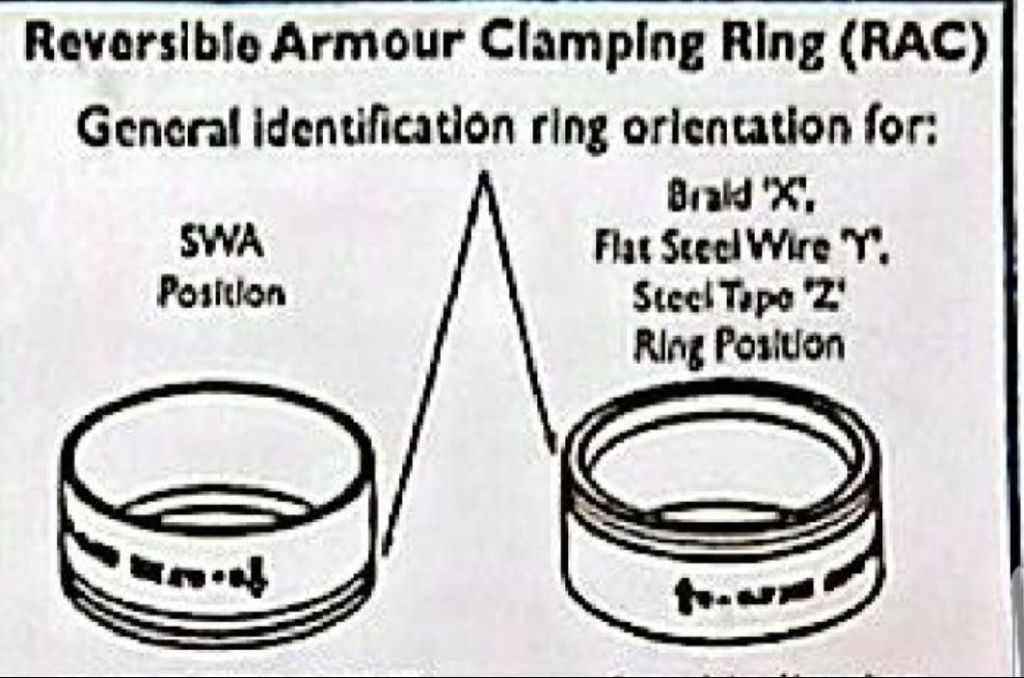
  • Use RAC “SWA” face when armour is round steel wires (SWA).
  • Use RAC “X/Y/Z” face when armour is braid (X), flat steel wire (Y), or steel tape (Z).
Step B — By Armour Thickness
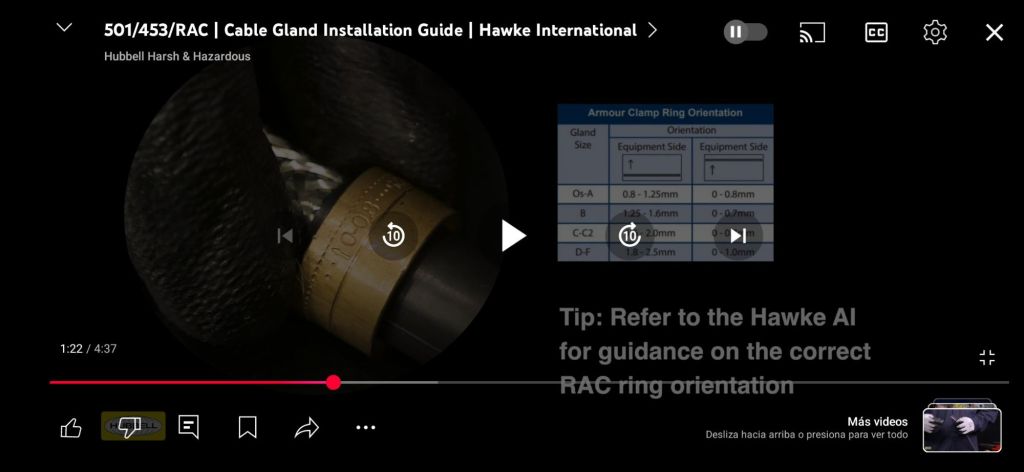
  • Hawke specifies Orientation 1/2 depending on armour thickness.
  • Select Orientation 1 or 2 strictly from the current Hawke size chart for your gland size.
  • If the measured armour is outside the permitted range for that size, select the next gland size up.

3) Cable Preparation

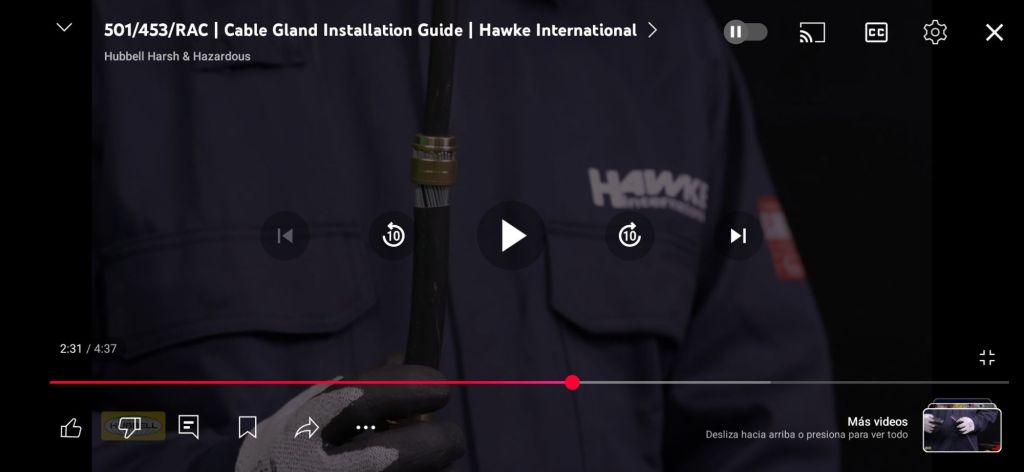
  1. Slide onto the cable in order: backnut → outer seal / shroud (if used) → middle nut → RAC (keep its chosen face ready).
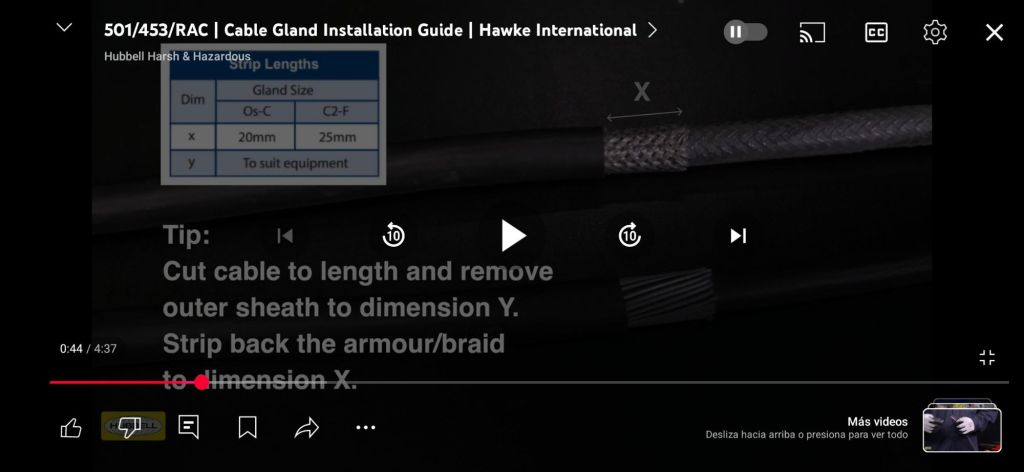
  2. Strip the outer sheath to the manual’s dimension “I” for your gland size (typical: ~20 mm for Os–C; ~25 mm for C2–F — confirm against the latest sheet).
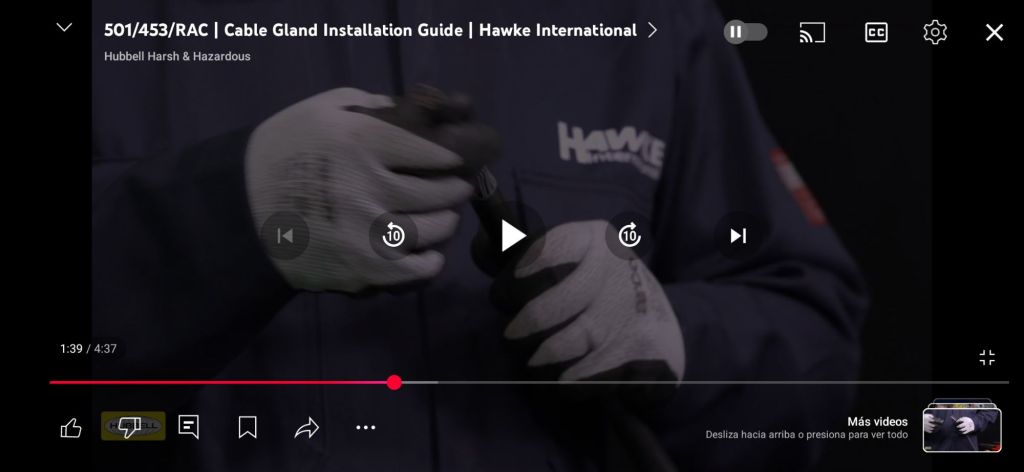
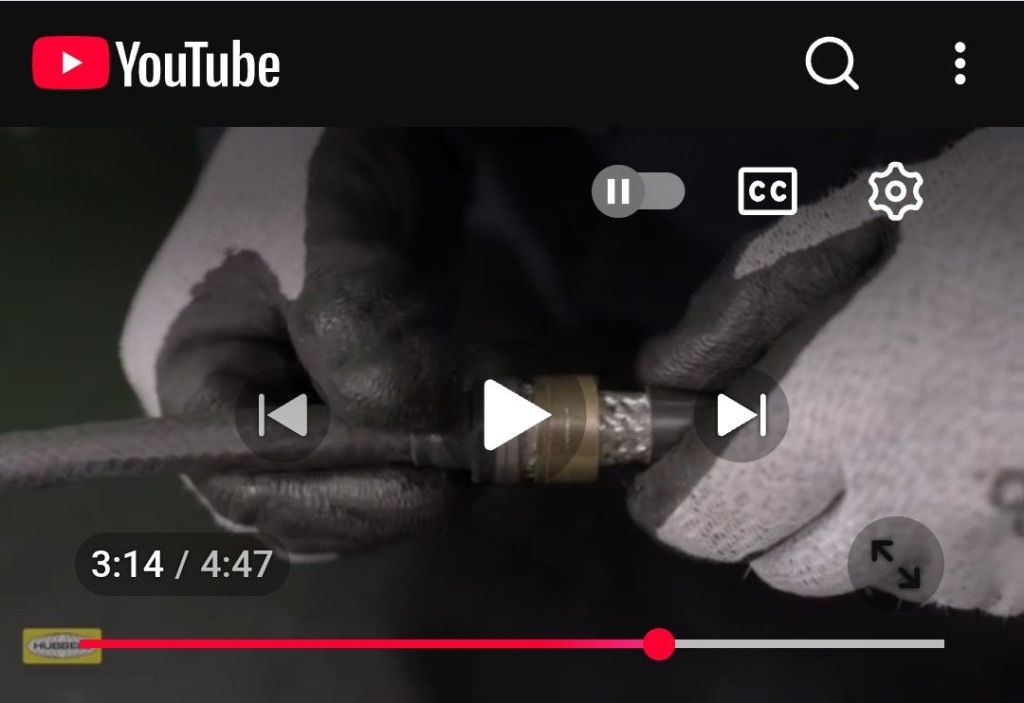
3. After clamping the armour/braid on the spigot, strip the inner sheath (bedding) to suit your termination; the manufacturer recommends leaving ~5 mm of inner sheath exposed beyond the gland entry before the conductor insulation begins.


4) Assembly (Applies to SWA and X/Y/Z)

  1. Mount the body into the equipment entry. Use a certified sealing washer/O-ring where IP66/67/69 or Ex e ingress protection is required. Tighten per equipment thread spec.
  2. Push the prepared cable fully home into the spigot/entry until bedding seats.
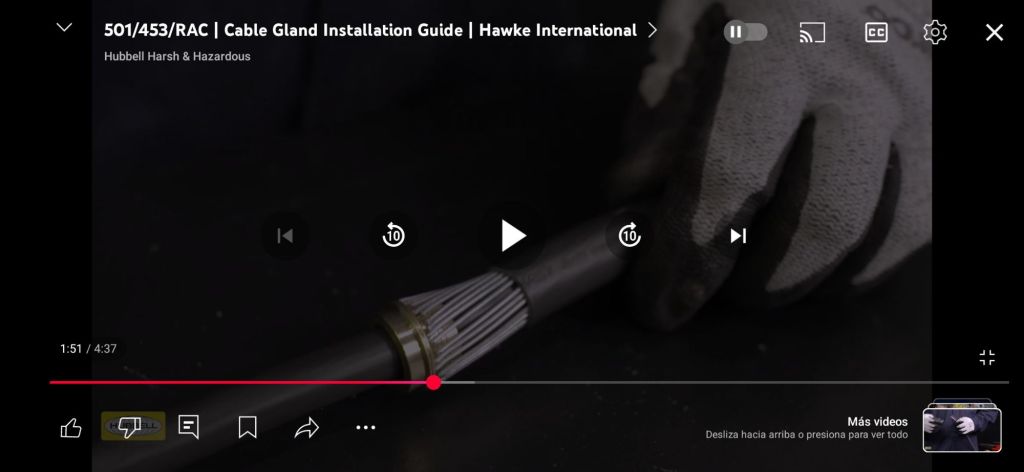
  3. Slide the RAC down with the selected face toward the armour and engage it so the armour is trapped onto the spigot shoulder 360°.
  4. Run up the middle nut hand-tight, ensuring armour remains evenly captured.
  5. Tighten middle nut then backnut to the Inbuilt Tightening Guide marks or the manufacturer torque value for the size. Do not over- or under-tighten.
  6. Fit shroud (if used). Confirm no twisting or gaps at seals.

5) Common Pitfalls to Avoid

  • Using SWA face on braid/tape (or X/Y/Z face on SWA).
  • Missing sealing washer where IP is required (typical Ex e mistake).

References (verified)

2025.10.19 – How a London Seashell Shop Became Shell plc – Tracing the Name, Logo, Merger & Global Energy Role

Key Takeaways

  • Shell plc is a British-Dutch (Anglo-Dutch) energy and petrochemical company whose legal seat is in London, United Kingdom since January 2022.
  • The name “Shell” comes from a London business founded in 1833 by Marcus Samuel that imported decorative seashells and later expanded into kerosene and oil.
  • In 1897 the company became The Shell Transport and Trading Company Ltd. and in 1907 it merged with the Dutch Royal Dutch Petroleum Company to form the Royal Dutch/Shell Group.
  • The company logo is a stylised seashell (the “pecten”, based on Pecten maximus) and the modern red-and-yellow version comes from a 1971 redesign by Raymond Loewy.
  • Today Shell plc is one of the major global energy companies (“supermajors”) and is actively shifting into natural gas, bio-fuels, hydrogen and renewable electricity.

Identity of Shell plc

Shell plc is an Anglo-Dutch (British and Dutch) company operating in the energy and petrochemical sector. Its activities include exploration, production, refining, distribution, renewable energy and chemical operations. Since its restructuring, the legal seat is in London, United Kingdom.

The Story Behind the Name “Shell”

The company’s name originates from a London import shop established in 1833 by Marcus Samuel. This shop specialised in selling imported decorative seashells (“shells”) from the Far East. Over time, the Samuel family business shifted into kerosene and oil trade. The brand name “Shell” was adopted when the oil business emerged.
The seashell motif thus reflects the business’s earliest identity rather than a later marketing invention.

Foundation and Evolution

  • In 1897 the company became The Shell Transport and Trading Company Ltd., building on the Samuel family’s oil-transport and trading business.
  • In 1907 the British company merged with the Dutch Royal Dutch Petroleum Company. The Dutch side brought production and refining, and the British side brought transport and marketing, forming the Royal Dutch/Shell Group.
  • Over time, the dual structure was simplified and in January 2022 the unified entity became Shell plc, with legal seat in London, United Kingdom.

Logo and Symbol

The company’s emblem is a stylised seashell known as the “pecten” (named after the giant scallop Pecten maximus). The modern red-and-yellow logo was created in 1971 by industrial designer Raymond Loewy. The colours may reference early service-station signage or maritime signalling. Over time the shell emblem has become one of the most recognised corporate symbols globally.

Current Position and Transition

Shell plc is recognised as one of the world’s major oil-and-gas companies (commonly referred to as “supermajors”). The company is actively transitioning toward cleaner energy: incorporating natural gas, bio-fuels, hydrogen and renewable electricity into its portfolio. This shift reflects broader energy-market dynamics and environmental imperatives.

Key Milestones at a Glance

  • 1833 : Marcus Samuel founded a London import business selling decorative seashells.
  • 1897 : The Shell Transport and Trading Company Ltd. established.
  • 1907 : Merger of Shell Transport & Trading with Royal Dutch Petroleum Company forming the Royal Dutch/Shell Group.
  • 1971 : The modern shell/pecten logo designed by Raymond Loewy.
  • January 2022 : Corporate restructure leads to Shell plc, headquartered in London.

Definitions

Pecten
– A term referring to a scallop shell, from Latin.
– In this context, it is the shape used for Shell’s logo.
– Professionally accepted in branding and corporate-identity discussions.

Supermajors
– Refers to the largest non-state-owned oil and gas companies globally.
– The term is widely used in the energy sector.

Entities & Roles

  • Marcus Samuel – Entrepreneur who founded the seashell import business in London and later the trading company.
  • Royal Dutch Petroleum Company – Dutch oil company that merged with Shell Transport & Trading in 1907.
  • The Shell Transport and Trading Company Ltd. – British predecessor company (founded 1897).
  • Shell plc – Current unified corporate entity with legal seat in London.
  • Raymond Loewy – Industrial designer who created the 1971 version of the logo.

Conclusions

  • Shell plc’s heritage shows remarkable continuity: from a small London shop selling shells in 1833 to a global energy enterprise today.
  • The adoption of the name “Shell” and the seashell-logo stem directly from that original trade.
  • The 1907 merger was a pivotal moment that combined Dutch production/refining strength with British transport/marketing operations, enabling global scale.
  • Today’s Shell plc builds on that legacy but is actively repositioning for the energy transition, signalling adaptation to changing markets and environmental demands.

Sources

2025.10.19 – How to Regain Emotional Balance When Life Disrupts You: Coherence, Reappraisal, and Resilience Across Psychology and Neuroscience

Context and Scope

This article explains how the mind learns self-regulation by seeking coherence among thoughts, emotions, and actions. It integrates cognitive appraisal, emotion regulation, learning through imbalance, and resilience. Emphasis is on practical understanding supported by established psychology and neuroscience.

Coherence: Why the Mind Doesn’t Seek Constant Calm

The mind functions as a dynamic system that continually aligns thinking, feeling, and doing. Disruption—loss, criticism, disappointment—temporarily breaks this alignment. That imbalance is not failure; it is the signal for reorganization. Stability grows from moving through change, not from avoiding it.

Interpretation Changes Emotion

Events don’t dictate feelings—interpretations do. The same criticism can evoke shame if read as “personal failure,” or curiosity if framed as “useful feedback.” Two people can face the same event and feel different emotions because they tell different stories about what it means.

How Self-Regulation Works in Practice

A helpful loop:
Event → Interpretation → Emotion → Response → Readjustment → New Equilibrium

Examples:

  • Feedback at work leads to either avoidance or engagement, then a new balance after learning.
  • Grief oscillates between remembering and re-engaging with life, gradually forming a new connection.
  • Childhood frustrations train patience and recovery through repeated small reorganizations.

From Imbalance to Growth

Discomfort from contradiction often marks transformation in progress. Classic findings show that inconsistency pushes change (cognitive dissonance) and that learning advances through temporary imbalance (disequilibrium). Emotional pain can be reframed as information: it highlights where reorganization is needed.

Flexible Balance

Psychological balance is the capacity to bend without breaking. Research on resilience highlights the brain’s ability to recover and adapt. Flexibility strengthens through:

  • Mindfulness: noticing inner states without being swept away.
  • Cognitive reappraisal: shifting the lens through which events are interpreted.
  • Connection: using relationships as regulatory resources.

Turning Turbulence into Meaning

Every inner conflict is an invitation to reorganize. Learning is more than absorbing facts—it is restructuring experience so life feels more intelligible, integrated, and alive.

Cognitive Appraisal (definition)

Plain English: The process of evaluating how an event affects goals, well-being, and coping resources, which in turn shapes emotion.
Linguistic note: “Appraisal” derives from English usage in psychology; no special borrowing.
Acceptance: Core construct in emotion science and widely cited in peer-reviewed research.

Emotion Regulation (definition)

Plain English: The ways people influence which emotions they have, when they occur, and how they are experienced or expressed.
Linguistic note: English technical term in psychology.
Acceptance: Foundational concept in affective science; supported by extensive experimental and clinical literature.

Self-Regulation (definition)

Plain English: Guiding one’s thoughts, emotions, and actions toward meaningful goals and healthy functioning.
Linguistic note: Standard English term across psychology and education.
Acceptance: Broadly used in research on motivation, coping, and behavior change.

Disequilibrium (definition)

Plain English: A temporary state of imbalance that prompts reorganization and learning.
Linguistic note: From Latin roots via French/English; common in developmental psychology.
Acceptance: Central to theories of learning and cognitive development.

Congruence (definition)

Plain English: Alignment between inner experience and one’s ideals or values.
Linguistic note: English term used in humanistic psychology.
Acceptance: Established concept in counseling and psychotherapy.

Sources

2025.10.18 – From Reality Fame to Controversy and Reinvention: The Journey of Eloy Ayrton Rivera

Key Takeaways

  • Eloy Ayrton Rivera first became widely known after participating in Gran Hermano Argentina 2015 (the Argentine version of Big Brother).
  • His time in the house lasted 57 days and he placed 16th.
  • Post-show, he built a career as an influencer and later presented himself publicly as a digital-marketing entrepreneur.
  • In April 2023, he was involved in a violent incident with his former partner Thalía Di Mario and her then-boyfriend Franco Coronel; Rivera was hospitalised and arrested.
  • His current online persona (as of 2025) emphasizes a role as “CEO & Sales Director” specialising in monetising digital profiles, and he is approximately 29-30 years old.

A Step-by-Step View of His Path

Reality TV Beginnings

Rivera entered the public eye through his participation in Gran Hermano Argentina 2015, the eighth season of the show. He originated from Burzaco, Buenos Aires Province, and was evicted after 57 days, finishing 16th.

Building a Platform

After his stint on reality TV, Rivera used his public exposure to grow a social-media presence and work as an influencer—a common path for reality-show alumni in Argentina and beyond.

The 2023 Incident: A Turning Point

On 14 April 2023 in the Palermo neighbourhood of Buenos Aires, Rivera was reportedly involved in a physical altercation with his ex-partner Thalía Di Mario and her then-boyfriend Franco Coronel. A video published by press shows Rivera without a shirt beside Di Mario at a building entrance, leading to a violent exchange during which Rivera was stabbed. He was hospitalised at Hospital Fernández and subsequently placed under police custody. The case includes allegations of attempted homicide.

Reinvention and Current Persona

As of late 2025, Rivera’s verified Instagram account presents him as “CEO & Sales Director – Transforming profiles into money machines,” indicating a shift toward digital-marketing consulting and personal-brand monetisation. While earlier reports mentioned a period of adult-content creation during a stay in Mexico, his public profile now emphasises business strategy and social-media growth services.

Relationship Landscape

  • Former partner: Thalía Di Mario (with whom Rivera had ended a relationship before the 2023 incident).
  • Her then-boyfriend (at time of incident): Franco Coronel, social-media influencer who engaged in the confrontation with Rivera.
  • Rivera’s relationship with Di Mario had reportedly concluded prior to the critical April encounter.

Definitions & Terms

Reality show

A television programme in which participants live together in isolation while being continuously filmed and gradually eliminated until one remains. Widely used in media studies and popular culture.

Influencer

An individual who has built a significant online following and whose content or endorsements influence the behaviour or opinions of others. A standard concept within digital-marketing discourse.

Digital-profile monetisation

The process of generating income from online profiles (such as social-media accounts or personal-brand assets) through coaching, sponsored content, consulting or similar services. Not formally regulated but commonly referenced in marketing literature.

Reflections

Eloy Ayrton Rivera’s story highlights how early exposure in reality television can create opportunities—but also how public life may lead to turbulence. His journey from reality-show contestant to influencer, through a highly publicised legal and violent episode, and toward an entrepreneurial digital identity suggests both reinvention and the challenge of sustaining a public persona in evolving contexts. The long-term stability of his current path remains to be seen.

Sources

2025.10.18 – How to Flourish: Meaning, Mindfulness, Action & Connection in Evidence-Based Psychology

Key Takeaways

  • Modern psychology combines rigorous research with compassionate human care.
  • Eight key approaches — meaning-centred therapy; mindfulness-based interventions (MBIs); behavioural activation (BA); acceptance and commitment therapy (ACT); self-compassion; attachment theory; vulnerability & authenticity; everyday self-regulation — offer well-supported, practical ways to improve mental health.
  • Each approach links a core idea, evidence base and simple practice you can adopt right away.

Meaning-Centred Therapy (Logotherapy)

Core concept: When suffering is tied to meaning or purpose, it becomes more bearable.
What it does: Guides people to discover their values, goals and personal significance even in adversity.
Evidence: Interventions that focus on meaning reduce depressive symptoms and enhance life satisfaction.
Practice: Ask yourself: “What purpose can I serve right now?” instead of “Why is this happening to me?”.

Mindfulness-Based Interventions (MBIs)

Origin: Developed by Jon Kabat-Zinn at the University of Massachusetts Medical School.
Definition: Paying deliberate, non-judgemental attention to the present moment.
Evidence: Meta-analytic studies show MBIs lower anxiety, depression and stress, and improve emotional regulation.
Practice: Spend 60 seconds observing your breathing. Notice sensations (warm, cool, tense) without trying to change them.
Watch: Jon Kabat-Zinn – “What Is Mindfulness?” (YouTube)

Behavioural Activation (BA)

Core principle: Taking action precedes motivation; by engaging in small, meaningful activities we reignite emotional energy.
Evidence: A meta-analysis of 26 randomized trials found BA superior to control conditions and even medication for depression treatment.
Practice: Choose one valued activity today — for example, cook a simple meal, take a short walk or do a bit of cleaning — and then note how your mood shifts.

Acceptance and Commitment Therapy (ACT)

Goal: Accept internal experiences and commit to actions aligned with personal values.
Six processes: acceptance; cognitive defusion; present-moment awareness; self-as-context; values; committed action.
Evidence: Meta-analytic findings show ACT is effective in reducing anxiety, depression, chronic pain and improving quality of life.
Practice: When a recurring thought arises (“I’m not enough”), acknowledge it (“Here’s the ‘I’m not enough’ story”) and then ask: “What meaningful action will I take now that aligns with my values?”

Self-Compassion

Researcher: Kristin Neff
Definition: Treating yourself with the same kindness and understanding you would offer a good friend—self-kindness, shared humanity, mindfulness.
Evidence: Meta-analyses report that self-compassion interventions increase resilience, reduce stress and lower levels of self-criticism.
Practice: When you experience a setback or fail, say to yourself: “This is human; I can learn and try again.”

Attachment Theory

Founders: John Bowlby and Mary Ainsworth
Concept: Humans are wired to seek safe emotional bonds; those bonds create a feeling of security even when we are physically apart.
Evidence: Secure attachment predicts better emotional regulation and healthier long-term outcomes.
Practice: If you feel alone or unsettled, bring to mind someone whose support you deeply felt—this reminder can activate soothing neural circuits.

Vulnerability and Authenticity

Researcher: Brené Brown and social psychology findings
Idea: Showing vulnerability and being authentic foster trust and deepen connections; vulnerability is a strength, not a weakness.
Evidence: Self-disclosure and authenticity increase empathy, belonging and emotional intimacy in relationships.
Practice: Share one honest feeling today with someone you trust: “I felt uncertain today because…”.

Everyday Self-Regulation

Concept: Small, repeated grounding actions restore a sense of control and reduce stress.
Examples: Brief cleaning, walking, focused breathing, organising a small space.
Evidence: People who adopt mindful daily routines report lower anxiety and greater life satisfaction.
Practice: Spend two minutes tidying up a corner of your space or taking slow, intentional breaths—focus solely on the sensation of calm and movement.

Conclusions

These eight approaches show how evidence-based psychology merges scientific insight with humanity. Healing often begins not by eliminating pain but by engaging life meaningfully: cultivating awareness, taking valued action, accepting experience, offering ourselves kindness, connecting with others, showing vulnerability, and establishing purposeful routine.

Sources

2025.10.18 – How to Navigate Mexico’s 2025–26 Tax and Utility Landscape: From Rumours to Reform and the Key Difference Between IVA and ISR

Key Takeaways

  • There is no verified government decision stating that all taxes in Mexico will be doubled starting October 2025.
  • The “2026 Economic Package,” submitted on 8 September 2025 (Europe/Amsterdam time), proposes selective tax reforms—especially affecting the Excise Tax on Production and Services (IEPS), Value-Added Tax (VAT), and digital-economy reporting obligations.
  • For most households and regular taxpayers subject to Income Tax (ISR) or VAT, major changes are not expected until 1 January 2026, and subject to legislative approval.
  • Utility-cost increases (electricity, water, gas) are more likely tied to inflation or consumption tiers—not a sweeping tax-rate doubling.
  • Understanding the core distinction between IVA (consumption tax) and ISR (income tax) clarifies how tax policy affects spending versus earning.

Outline of Coverage

The following text covers all discussion points from the beginning of this thread up to 18 October 2025 (Europe/Amsterdam time). It addresses: the tax-doubling rumour, individual taxpayer concerns regarding the Mexican tax authority (SAT), utility cost questions, explanations of IVA versus ISR, and the reform proposals contained in the 2026 Economic Package.

The Rumour vs Verified Facts

Online claims suggested that Mexican taxes would automatically double from October 2025. A review of official sources found no universal doubling measure. Instead, the reforms under consideration are targeted—applying to specific goods, services or digital economy transactions—not to all taxpayers.

What the 2026 Economic Package Actually Proposes

  • On 8 September 2025 the federal executive submitted its 2026 Economic Package to Congress, introducing reforms to VAT, IEPS, the Federal Tax Code and customs/tariff laws.
  • Key proposals include:
  • VAT and income-tax withholding rules for digital platforms: e.g., 50 % VAT withholding + 4 % income-tax on sellers with Mexican tax ID; 100 % VAT withholding + 20 % income-tax when no tax ID is provided.
  • IEPS increases: gambling and sweepstakes tax may rise from ~30 % to 50 %; flavoured beverages in Mexico may face an 87 % excise-quota rise; violent or adult-content video games may face 8 % IEPS plus 16 % VAT.
  • Tariff and customs reforms: import duties on goods from countries without a Free Trade Agreement (FTA) may increase up to 50 % for certain classifications.
  • These changes are not yet law and many are set for 1 January 2026 if approved and enacted.

What It Means for Taxpayers & Households

  • If you pay taxes to SAT: your standard ISR and VAT rates remain stable for 2025. Major changes are unlikely in that year.
  • If your consumption of electricity, water or gas stays the same: any increase in bills will likely stem from inflation or regulatory adjustments rather than a blanket tax hike.
  • If you operate via digital platforms, or sell goods/services in sectors targeted by the reform (gambling, sugary drinks, adult-games, some imports), you may face enhanced compliance or higher rates in 2026.
  • As the reforms still require congressional approval, the final wording, thresholds and effective dates may shift.

Why the Government Is Making These Changes

  • Mexico’s tax-revenue-to-GDP ratio is relatively low; the government seeks to strengthen the fiscal base without broad tax hikes on all citizens.
  • The reform agenda emphasises:
  • Expanding the tax base (especially digital platforms and non-resident sellers)
  • Improving enforcement and closing loopholes (e-invoicing, real-time data, stronger auditing)
  • Imposing so-called “healthy taxes” on products with societal cost (sugary drinks, tobacco, gambling)
  • Supporting domestic industry by increasing tariffs on imports from non-FTA countries.

Understanding the Key Taxes

Value-Added Tax (VAT)

An indirect tax on the consumption of goods and services. In Mexico, the general rate is 16 %. Consumers bear the cost; businesses collect it and remit it to SAT.

Income Tax (ISR)

A direct tax levied on income or profit of individuals and companies. Rates in Mexico vary: individuals face progressive rates (approximately 1.92 % up to ~35 %) and companies typically around 30 % of net profit.

Key Difference

VAT taxes what you spend; ISR taxes what you earn. This distinction helps explain why changes in utility bills (consumption) differ from tax obligations on earnings.

Conclusions

  • The narrative that all taxes in Mexico will double from October 2025 lacks factual support.
  • Tax reform exists, but it is selective, aimed at certain sectors, with most changes planned for 2026.
  • For most households and individual taxpayers, the short-term impact is modest.
  • Having clarity on the difference between VAT and ISR helps understand how policy changes may affect your spending or earnings.
  • Keeping an eye on official sources and final legislative developments will be important as reforms progress.

Sources

2025.10.18 – Ray Dylan’s Resonant Cover of “I Want to Know What Love Is” — A Love Anthem Flowing Across Cultures

Key Takeaways

  • South African singer Ray Dylan performs a heartfelt cover of “I Want to Know What Love Is”, originally by the British-American rock band Foreigner.
  • The song was written by Mick Jones and first released in November 1984.
  • Ray Dylan’s version appears on his album Hokaai Stoppie Lorrie, released 10 February 2006 (Europe/Amsterdam time zone).
  • Verified metadata confirms the track’s presence on major platforms, and a working YouTube link for the song is available.
  • The cover maintains the original lyrics and emotion while offering a distinctly South African interpretation.

What You Need to Know

Foreigner’s “I Want to Know What Love Is” became a worldwide hit, celebrated for its combination of soft-rock instrumentation and gospel-inspired vocals.
Ray Dylan, known for his work in both English and Afrikaans, brought this classic into his own repertoire. His 2006 cover honors the same yearning for love and emotional openness that defined the original.
As listed on Shazam, Apple Music and Last.fm, the song credits Mick Jones as its composer, confirming it as a faithful rendition.
The verified YouTube upload on Ray Dylan’s official channel provides listeners with a clear version of the track.
By placing his voice within such an iconic melody, Dylan bridges generations and cultures, showing how music about love retains power across time and geography.

Context & Background

The Original by Foreigner

Released in November 1984 as part of the album Agent Provocateur, Foreigner’s version reached number 1 on both the UK and US charts. Its mix of rock and soul, enhanced by the New Jersey Mass Choir, made it one of the defining love anthems of the 1980s.

Ray Dylan’s Version

Ray Dylan’s interpretation, included on Hokaai Stoppie Lorrie, came out on 10 February 2006. Sources confirm the songwriter credit to Mick Jones, keeping the composition unchanged.
His voice and arrangement give the song a gentler tone, merging elements of soft rock and South African country pop.

Cultural Significance

Covers like Dylan’s highlight how universal themes—love, vulnerability, and hope—can move freely between musical traditions. This cross-cultural continuity illustrates music’s ability to unite audiences beyond language and origin.

Artists & Contributors

  • Ray Dylan — South African singer; performer of the 2006 cover.
  • Mick Jones — English songwriter and producer; original author of “I Want to Know What Love Is.”
  • Foreigner — British-American rock band; creators of the 1984 original recording.
  • Shazam, Apple Music, Last.fm — Platforms confirming metadata, release date, and authorship.
  • YouTube — Video platform hosting Ray Dylan’s verified content, including this cover.

Conclusions

Ray Dylan’s rendition of “I Want to Know What Love Is” offers a touching blend of homage and individuality. The song’s message—longing to understand and feel love—remains unchanged, yet Dylan’s approach infuses it with warmth rooted in his South African musical background.
Listening to both versions reveals how music transcends origin: one melody, many voices, all reaching for the same emotion.

Sources

2025.10.18 – How Tone, Respect and Authenticity Foster Trust, Psychological Safety and Collaboration at Work

Key Takeaways

  • The emotional flavour of every workplace message—whether in writing or speech—shapes trust, psychological safety and how well teams collaborate.
  • Authenticity—where your intention aligns with your expression—builds credibility and deepens relationships.
  • Even in cultures that value direct communication (such as Northern European or Dutch-style environments), a calm, factual, human tone strengthens engagement and cooperation.
  • Leaders set the tone for culture: their consistent use of respectful, transparent dialogue influences how everyone else interacts.

Why Tone and Authenticity Matter

The tone you choose adds emotional context to what you say. Authenticity means your voice matches your intention, which boosts your credibility and trust with others. Together, they transform routine exchanges into opportunities to build psychological safety—a climate in which team members feel free to ask questions, admit mistakes and contribute without fear.

Research finds that leadership communication plays a crucial role. A study at the 0 (US, 17 October 2023) showed that respectful, affirming communication by leaders contributes to a culture of respect and higher employee engagement.
Another article in 1 emphasises that tone “can make all the difference between successful communication and miscommunication.”

Clarity of intent matters—but how you express that intent matters at least as much.

Core Principles for Respectful, Authentic Communication

  • Focus on facts, not assumptions.
    Describe concrete observations or agreements—not rather what you think someone intended.
  • Be concise and structured.
    Short paragraphs, clear transitions and logical ordering help readers follow easily and reduce misinterpretation.
  • Acknowledge the other person’s role or effort.
    Even in administrative or logistical messages, a quick note of thanks or acknowledgement makes the message more human.
  • Pause and fine-tune your tone.
    Before hitting “send” or speaking, imagine you are in the recipient’s shoes. Does the phrasing match your intention? When emotions are involved, waiting briefly can help.
  • Invite dialogue and listen actively.
    Ask clarifying questions, reflect back what you heard, and confirm understanding—this builds mutual understanding.
  • Be reliable and follow through.
    Consistently acting on what you say strengthens your credibility.
  • Adapt to context and individual style.
    Some colleagues appreciate blunt precision; others prefer a warmer buffer. Notice the preference and adapt—while remaining genuine.

Understanding Communication Styles

Here’s a simple typology that helps you recognise how others might prefer to communicate and how you might adjust your own tone:

  • Assertive: clear, open expression that respects others.
  • Passive: avoids expressing needs or conflict.
  • Aggressive: forceful, often disregards others’ feelings.
  • Passive-Aggressive: conveys negativity indirectly.

If you’re dealing with someone who tends toward defensive or forceful communication, responding with a calm, fact-based, solution-oriented tone can help de-escalate tension and open up dialogue.

Strategies to Cultivate Trust Through Communication

  • Transparency: explain relevant reasoning or context so people understand the “why.”
  • Empathy & Active Listening: reflect what you hear, ask open questions and validate the other person’s perspective.
  • Structured difficult conversations:
  • Step 1: describe what you observed.
  • Step 2: invite the other person’s view.
  • Step 3: co-create next steps together.
  • Emotional self-awareness: notice when you’re frustrated or defensive, pause, and then respond deliberately.
  • Regular recognition: small acknowledgements count as much as big wins.
  • Feedback on your tone: ask, “Did this message come across as I intended?” and adjust.
  • Set gentle boundaries: clarify expectations around timing, availability and tone—without being rigid.

Common Missteps and How to Avoid Them

  • Overly formal tone: Can feel distant or cold; opt for human phrasing.
  • Hedging language (“just,” “maybe”): Weakens clarity; remove unnecessary softeners.
  • Reacting while emotional: Can escalate situations; draft, wait, then revise.
  • Mismatch between tone and content: Gentle wording delivering a harsh demand confuses trust; ensure words and intent align.
  • Ignoring non-verbal cues: If your body language or voice contradicts your words, you undermine your tone; be consistent across channels.

Before & After: Tone in Action

Example 1 – Blunt → Courteous

  • Before: “Send the report today. You’re behind.”
  • After: “Could you please send the report by end of day? Thank you—I need it to move the next step forward.”

Example 2 – Reactive → Constructive

  • Before: “I don’t understand why this happened. It’s frustrating.”
  • After: “I noticed the deadline wasn’t met. What got in the way? I’d like us to avoid this going forward—and I’m happy to help if needed.”

Term: Tone

Definition: The emotional dimension of a message (written or spoken) that influences how it is interpreted.
Origin/Note: Common English term, used widely in communication research.
Acceptance: Recognised in organisational behaviour as a critical variable in interpersonal and leadership communication.

Term: Authenticity

Definition: When the intention and expression match, giving the message sincerity and credibility rather than a performative feel.
Origin/Note: From Latin authenticus, via English usage; broadly adopted in leadership and trust research.
Acceptance: Central concept in trust-building and leadership authenticity models.

Term: Direct Communication

Definition: A style that emphasises clarity, brevity and plain speaking.
Origin/Note: Commonly referenced in Northern European and Dutch work cultures.
Acceptance: Recognized in cross-cultural communication studies as a distinct style.

Term: Psychological Safety

Definition: A shared belief in a team that full participation—asking questions, admitting mistakes or suggesting ideas—can happen without fear of negative consequences.
Origin/Note: Introduced in organisational psychology by 2 (1999).
Acceptance: Widely used in leadership, team dynamics and collaboration research.

Term: Active Listening

Definition: A listening method where you reflect back what you heard, ask clarifying questions and confirm understanding before responding.
Origin/Note: Rooted in counselling and communication theory.
Acceptance: Considered best-practice in leadership and conflict-resolution training.

Term: Administrative Message

Definition: Functional communication about tasks, procedures, scheduling or logistics, where clarity and tone still enhance cooperation.
Origin/Note: Derives from organisational communication practice.
Acceptance: Common in corporate-communications training.

Reflection

Every message—whether a quick administrative note, feedback, or scheduling email—contributes to the tone of your team. When clarity, respect and authenticity come together, communication becomes an opportunity to build connection and trust. The aim is not perfect phrasing—it is consistent, human communication that supports good work and healthy relationships.

Sources

2025.10.18 – Transforming Unused Body Talc Into Smart Home Helpers & DIY Solutions

Key Takeaways

  • A container of body talc (or similar powdered product) doesn’t have to languish — it can be repurposed for freshening, cleaning, fabric care and light DIY around the house.
  • The core properties that make talc useful on skin (absorbing moisture, reducing friction, neutralising odours) lend themselves to home-care tasks.
  • This guide explains how to apply those properties in three major zones: everyday home cleaning, clothing/fabric care, and garden/tool/vehicle tasks.

Why This Matters

Rather than discarding a powder you no longer wish to apply on your skin, you can instead redirect it to practical uses at home. From shoes and trash bins to wardrobe drawers and garden gloves, body talc becomes an inexpensive tool for maintenance, saving cost and waste. The ideas here draw on credible publications and usable hacks.

Everyday Home Cleaning Uses

Here are hands-on ways to make unsued body talc truly useful:

Freshen shoes, bags and bins

  • Sprinkle talc inside shoes or gym bags to absorb sweat and neutralise odours.
  • In the bottom of a trash bin, a light dusting helps manage damp smells and moisture.

Quiet squeaks & ease rubber surfaces

  • Between floorboards that creak, dust a little talc to reduce friction and silence squeaks.
  • Inside rubber gloves or boots: pour in some powder before storing to prevent sticking and reduce dampness.

Refresh mattresses, upholstery, and sandy skin

  • Lightly dust a mattress, rug or upholstery, wait a few minutes, then vacuum to remove embedded moisture or mild odours.
  • After a day at the beach or sandbox, sprinkle talc on damp skin or sandy feet; it absorbs moisture so sand brushes off easily.

Fabric & Clothing Care Uses

Though not the primary focus, these are valuable extras:

  • Oil/grease stains: Apply the powder onto the affected area, let it sit briefly to absorb the oil, then brush off and launder as usual.
  • Wardrobe freshness: Lightly dust inside drawers or on folded garments to absorb humidity and help clothes smell fresher.
  • Garden gloves or liners: A sprinkle inside will reduce moisture build-up and slipperiness during use.

Garden, Tool & Vehicle Maintenance Uses

Extend your powder’s usefulness beyond the house:

  • Use on rubber or plastic joints (like car door seals or garden tool handles) to reduce friction or sticking.
  • For bulbs or seeds: light dusting of powder helps mitigate moisture and may reduce fungal risk before planting.
  • Create a dry barrier: For example, a line of talc around a picnic area can help deter ants by disrupting their scent trails.

Definition: Talc

Talc is a clay mineral composed of hydrated magnesium silicate, ground into a fine powder.
It comes from natural mineral deposits and is widely used in industrial and consumer products—though inhalation and contamination risks exist if not handled properly.

Safety & Practical Notes

  • Always ensure good ventilation when using powders, and avoid inhaling large amounts.
  • If the product is very old or specifically marketed as “baby powder” (and still talc-based), check its ingredients for safety warnings.
  • Use minimal amounts—often a light shake or dusting suffices.
  • Test sensitive surfaces (like delicate fabrics) before wide application.

Closing Thoughts

Unused body talc needn’t be waste. With a mindful approach, it turns into a smart home-care tool—absorbing moisture, easing friction, freshening fabrics, and even aiding light DIY tasks. Just treat it as a household helper with purpose, and your home will thank you.

Sources

2025.10.18 – Bulgaria Is Switching to the Euro: What It Means for Your Revolut Account and Everyday Money

Key Points You Should Know

  • Bulgaria will adopt the euro (EUR) on January 1, 2026.
  • The exchange rate is fixed at 1 EUR = 1.95583 BGN (Bulgarian lev).
  • Revolut and other financial apps are updating their Terms & Conditions to reflect this change.
  • From December 17, 2025, all accounts in lev (BGN) will automatically convert to euros.
  • Sending or receiving money in BGN will no longer be possible after the set cut-off dates.
  • You don’t need to do anything — unless you’d rather close your account before the change.

Why Bulgaria Is Adopting the Euro

After years of preparation, Bulgaria will become the 21st member of the euro area on January 1, 2026.
The European Union confirmed the decision in July 2025, following economic checks known as the Convergence Reports by the European Central Bank (ECB) and the European Commission (EC).

This move ties Bulgaria more closely to Europe’s shared currency system, aiming for greater price stability, easier trade, and lower exchange costs.


What This Means for Your Revolut Account

1. Your BGN balance will become EUR automatically

If you have a Pocket (wallet) in Bulgarian lev (BGN), Revolut will automatically convert your balance to euros at the official rate 1 EUR = 1.95583 BGN on December 17, 2025.
There’s no fee, and your account details will stay the same.

2. Transfers in BGN will stop before the switch

You won’t be able to:

  • Send bank transfers in BGN after November 27, 2025.
  • Receive BGN transfers after December 10, 2025.

These cut-off dates allow the payment systems to prepare for the euro transition.

3. Fees will appear in euros

From December 17, 2025, Revolut will display and charge all standard fees — such as subscriptions or transaction costs — in EUR instead of BGN.
The fee amounts themselves won’t change; only the currency label will.

4. Group “Pockets” will close

If you share a group Pocket in BGN with friends or family, it will close automatically on December 17, 2025.
Any remaining balance will move to the group administrator’s main account and then be converted to euros.
If you prefer to divide the funds yourself, it’s best to do it before that date.

5. Chargebacks will use EUR

Even if a past payment was made in BGN, any refund or chargeback after December 17, 2025 will be processed in euros.


What You Should Do Now

  • Check your accounts for any BGN balances.
  • Stop sending or receiving BGN transfers before the deadlines.
  • Read Revolut’s updated Terms & Conditions when they become available in December 2025.
  • Plan ahead if you use BGN group Pockets or receive payments in that currency.
  • If you don’t agree with the updates, you can close your account for free at any time before the change.

The Bigger Picture

Bulgaria’s switch to the euro is part of its long-term integration into the European Union (EU) economy.
For customers of apps like Revolut, this means smoother travel within Europe, no conversion costs between BGN and EUR, and a simpler banking experience overall.
However, some Bulgarians remain cautious, worried about possible price increases — a common fear when new countries join the euro area.


Simple Definition

Euro (EUR)

The common currency used by 20 EU countries, managed by the European Central Bank (ECB) in Frankfurt. Bulgaria will be the 21st member to adopt it.

Lev (BGN)

Bulgaria’s national currency before 2026. It has been pegged to the euro since 1999 at a fixed rate of 1.95583 BGN = 1 EUR.


Timeline at a Glance

  • July 10, 2020 – Bulgaria joins ERM II (Exchange Rate Mechanism II), the waiting room for adopting the euro.
  • June 4, 2025ECB and EC confirm Bulgaria meets all requirements.
  • July 8, 2025EU Council approves Bulgaria’s entry on January 1, 2026.
  • November 27, 2025 – Last day to send BGN transfers via Revolut.
  • December 10, 2025 – Last day to receive BGN transfers.
  • December 17, 2025 – Revolut updates Terms & Conditions; all BGN wallets convert to EUR.
  • January 1, 2026 – The euro officially becomes Bulgaria’s currency.

Sources (all verified and live)


(All information verified on October 18, 2025, Europe/Amsterdam time.)

Design a site like this with WordPress.com
Get started